Meta Ads (Facebook & Instagram): A Practical Guide for Businesses
Stop boosting posts and start running campaigns: objectives, audience layers, creative testing, lead forms, retargeting and optimization for Facebook & Instagram Ads.
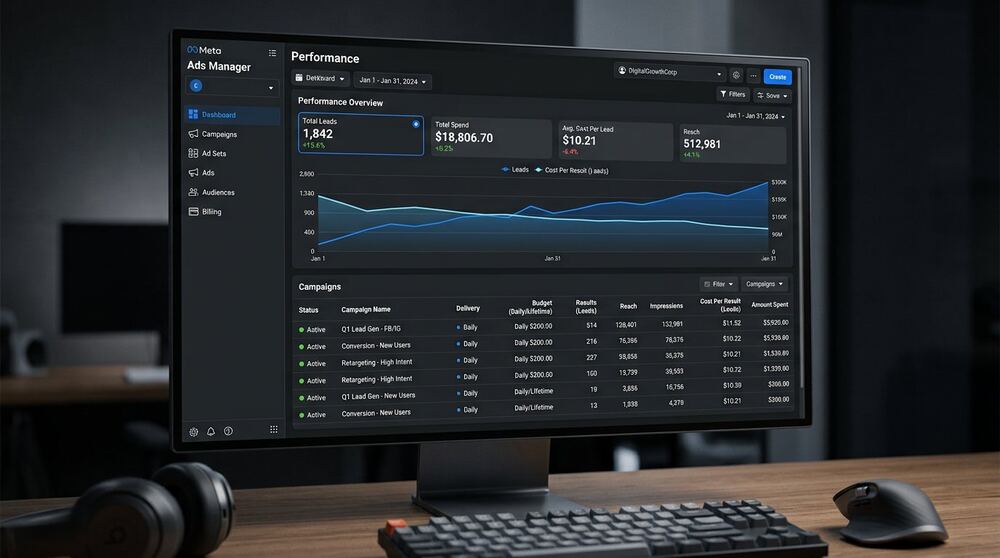
Meta Ads — Facebook and Instagram advertising — create demand instead of capturing it. Nobody opens Instagram looking for your service, which means success depends on interrupting the right people with the right creative and giving them a frictionless next step. This guide covers the practical system: objectives, audiences, creative testing, lead handling and retargeting, without hype and without jargon.
How Meta Ads differ from Google Ads
Google answers existing intent; Meta manufactures attention. Consequences: Meta needs stronger creative (the ad is the targeting, increasingly), simpler offers work better, and lead quality varies more — which is why qualification inside the funnel matters so much. Many businesses ultimately run both: Google for high-intent capture, Meta for prospecting and retargeting. The full comparison is in Google Ads vs Meta Ads.
Objectives: choose the outcome, not the activity
- Leads: instant forms for volume, website forms for quality. Add 2–4 qualification questions to filter curiosity clicks — fewer, better leads beat cheap junk.
- Sales: needs conversion tracking and enough volume for learning; start with your proven offers, not experiments.
- Engagement/Video views: support objectives — useful for warming audiences and testing creative angles cheaply before lead campaigns.
Rule: optimize toward the event closest to revenue that still produces enough volume to learn from.
Audiences: layers, not guesses
- Cold: interest stacks, lookalikes of customers or quality leads, broad with creative-led targeting. Keep audiences large enough to learn; hyper-narrow targeting usually backfires now.
- Warm: video viewers, page engagers, site visitors — the bridge between cold reach and conversion.
- Hot/retargeting: form starters who didn't submit, pricing-page visitors, past customers for upsell. Almost always the highest-ROI segment — see the retargeting guide.
Separate cold, warm and retargeting into distinct campaigns so budgets, messages and frequency stay controlled per temperature.
Creative: the real targeting lever
- Lead with the hook in the first 3 seconds (video) or first line (copy). No logos-first intros.
- One ad, one message, one CTA. Mixed messages produce mixed data.
- Test angles systematically: problem-led, outcome-led, proof-led, offer-led — then produce variants of winners.
- Native-looking creative usually beats polished studio ads in feed placements; keep branding consistent but not corporate.
- Refresh before fatigue: watch frequency and declining CTR, and rotate new variants into winning ad sets.
Lead handling: where Meta campaigns are won or lost
Meta leads go cold fast. Best practices: instant auto-response (WhatsApp, email or SMS within minutes), a defined follow-up sequence, and lead-to-sale tracking so optimization targets revenue, not form fills. If sales follow-up is slow, fix that before increasing ad spend — budget cannot compensate for a leaking bucket.
Measurement and optimization routine
- Verify Pixel/Conversions API events firing correctly — server-side tracking plus browser pixel for resilience.
- Review weekly: spend, qualified leads, cost per qualified lead by campaign and creative.
- Pause chronic underperformers; scale winners gradually; always keep one controlled test running.
- Report plainly: what changed, what it produced, what comes next.
Common Meta Ads mistakes
- Boosting posts instead of running structured Ads Manager campaigns.
- Optimizing to cheap leads with no qualification — then blaming the platform for junk.
- Audiences so narrow the algorithm cannot learn.
- One creative running for months until fatigue destroys performance.
- No retargeting while paying full price for every conversion.
Frequently asked questions
How much should a small business spend on Meta Ads?
Enough to sustain a 60–90 day learning period at meaningful volume — exact figures depend on your market and lead value. Start controlled, prove cost per qualified lead, then scale. Management starts from $50 setup — see pricing.
Are Facebook Ads still effective?
Yes — with proper structure. What stopped working is lazy advertising: boosted posts, broad messages, no follow-up. Structured campaigns with strong creative and fast lead handling still deliver in most B2C and many B2B niches.
Should I use instant forms or website landing pages?
Instant forms maximize volume; website pages (with qualification) maximize quality. Test both against cost per qualified lead. Either way, fast follow-up matters more than the form type.
Can you manage Meta Ads for international businesses?
Yes — ad accounts, audiences and reporting are location-independent, and I schedule reviews around your timezone. Ad spend is paid by you directly to Meta; your account stays under your ownership.
Continue reading
Related: Google Ads vs Meta Ads, the power of retargeting and social media marketing for small businesses. Need management? See paid advertising services or start a conversation.
Applied workbook: turn the guidance into a working plan
This section is for a business planning Facebook and Instagram campaigns. Its purpose is to help you combine audience learning, creative testing and reliable follow-up. It expands the principles above into a planning document you can use with a colleague, freelancer or agency. It is not a promise of a ranking, lead volume or return. Those outcomes depend on the market, offer, website, competition, budget and quality of execution.
Use this Meta Ads (Facebook & Instagram): A Practical Guide for Businesses workbook on one real priority rather than answering it in the abstract. A useful plan names the page, campaign, audience or dataset being discussed; identifies the evidence available today; and gives the next action to a specific owner. If information is missing, write that down as a research task instead of filling the gap with an assumption.
A realistic planning situation
Consider this hypothetical situation: a campaign uses one sales graphic for cold and warm audiences and judges success only by cheap form submissions. The example is intentionally general and does not describe a named client. It shows why the topic cannot be solved by copying a template. The right response begins by separating what is known from what merely sounds plausible.
For Meta Ads (Facebook & Instagram): A Practical Guide for Businesses, first describe the commercial objective in one sentence. Then describe what a useful visitor, lead or customer would do next. Finally, identify the present obstacle. It might be missing demand, weak relevance, technical friction, an unclear offer, poor measurement or insufficient follow-up. Each obstacle leads to different work, so this diagnosis prevents a tool from deciding the strategy.
For the Meta Ads (Facebook & Instagram): A Practical Guide for Businesses situation, create two columns: evidence and assumptions. Evidence may include search queries, campaign terms, page behavior, sales notes, crawl output or verified records, depending on the topic. The plan should test the most important assumption while protecting what the available evidence already supports.
Information to collect before implementation
Do not wait for perfect data, but collect enough information to avoid an expensive guess about Meta Ads (Facebook & Instagram): A Practical Guide for Businesses. The following inputs are specific to this topic:
- 1. offer and customer awareness level. Note its source, date and any limitation before using it to make a decision.
- 2. creative angles and formats. Note its source, date and any limitation before using it to make a decision.
- 3. audience, placement and exclusion plan. Note its source, date and any limitation before using it to make a decision.
- 4. pixel or server-side events and lead follow-up. Note its source, date and any limitation before using it to make a decision.
Place the Meta Ads (Facebook & Instagram): A Practical Guide for Businesses inputs in one brief. Add the target market, device or location where it changes the answer. For international work, terminology and competition can differ between the United States, United Kingdom, Canada, Australia, Europe and Bangladesh; that does not justify repeating country names throughout the copy. It means the research should reflect the audience that will actually see the page or campaign.
Finish the Meta Ads (Facebook & Instagram): A Practical Guide for Businesses brief with constraints: budget, deadline, access, approval time, technical capacity and legal or platform requirements. Constraints make priorities visible and help a specialist recommend a focused first phase instead of pretending every possible task belongs in the initial scope.
Four decisions to make deliberately
1. Separate audience temperature
Introduce the offer differently to cold prospects, engaged visitors and customers. Write down the current evidence before changing anything. Then make one controlled decision and record who owns the next action.
Working note for Separate audience temperature: connect this decision to combine audience learning, creative testing and reliable follow-up. Record the assumption, the evidence available now and the condition that would make you revise this specific choice. That keeps the work practical and prevents a checklist from replacing judgement.
2. Test ideas, not decoration
Vary the hook, proof or offer while keeping comparisons readable. Apply this to the page, campaign or workflow that matters most first. A narrow test is easier to interpret than a site-wide change made without a baseline.
Working note for Test ideas, not decoration: connect this decision to combine audience learning, creative testing and reliable follow-up. Record the assumption, the evidence available now and the condition that would make you revise this specific choice. That keeps the work practical and prevents a checklist from replacing judgement.
3. Choose the right destination
Use website or lead forms according to qualification and tracking needs. Explain the choice in plain language to the person approving the work. If the reason cannot be explained clearly, the scope probably needs more research.
Working note for Choose the right destination: connect this decision to combine audience learning, creative testing and reliable follow-up. Record the assumption, the evidence available now and the condition that would make you revise this specific choice. That keeps the work practical and prevents a checklist from replacing judgement.
4. Review downstream quality
Connect platform leads to replies, appointments or sales feedback. Set an explicit review point. The first implementation may reveal a different constraint, so the plan should allow evidence to change the next priority.
Working note for Review downstream quality: connect this decision to combine audience learning, creative testing and reliable follow-up. Record the assumption, the evidence available now and the condition that would make you revise this specific choice. That keeps the work practical and prevents a checklist from replacing judgement.
How to move from plan to implementation
Turn the four Meta Ads (Facebook & Instagram): A Practical Guide for Businesses decisions into a short backlog. Each item should contain an owner, the asset or account affected, the expected user benefit, the evidence behind it and a completion check. Broad instructions such as “improve it” are not executable; name the exact page, campaign, file or workflow and the check that will close the task.
For the Meta Ads (Facebook & Instagram): A Practical Guide for Businesses plan, work in dependency order. Measurement and access usually come before optimization, and a clear offer or source dataset comes before scaling distribution. The correct sequence reduces rework and makes later evidence easier to interpret.
Keep a dated change log for Meta Ads (Facebook & Instagram): A Practical Guide for Businesses. Record the content, technical, tracking, audience, creative or data rule that changed—whichever applies here. Platforms change continuously, but undocumented internal releases cause just as much confusion. A log separates deliberate work from seasonality and normal fluctuation.
Review the Meta Ads (Facebook & Instagram): A Practical Guide for Businesses implementation as the intended user would. Use the actual device, landing page, account view, spreadsheet or conversion path; then complete the intended task. Technical correctness matters, but the work is unfinished when a real person cannot understand or use it.
Measurement that supports a decision
A reporting dashboard for Meta Ads (Facebook & Instagram): A Practical Guide for Businesses is useful only when each number changes a decision. Start with the following topic-specific measures:
- qualified lead cost: define where the number comes from, how often it will be reviewed and what business question it answers. Compare like-for-like periods and annotate major releases or campaign changes.
- creative hold and click quality: define where the number comes from, how often it will be reviewed and what business question it answers. Compare like-for-like periods and annotate major releases or campaign changes.
- frequency and audience fatigue: define where the number comes from, how often it will be reviewed and what business question it answers. Compare like-for-like periods and annotate major releases or campaign changes.
- lead-to-opportunity outcome: define where the number comes from, how often it will be reviewed and what business question it answers. Compare like-for-like periods and annotate major releases or campaign changes.
For Meta Ads (Facebook & Instagram): A Practical Guide for Businesses, use both leading and outcome indicators. A leading indicator shows whether implementation is moving in the intended direction; an outcome indicator shows whether that direction supports the business. The measures listed above make that distinction concrete, and neither group should be interpreted alone.
Avoid presenting correlation as certainty when reporting on Meta Ads (Facebook & Instagram): A Practical Guide for Businesses. Traffic, cost or conversion can change because of seasonality, competitors, pricing, creative, tracking or demand. Report the release, the observation and the next test instead of claiming credit the data cannot isolate.
Quality-control and risk review
Before calling the Meta Ads (Facebook & Instagram): A Practical Guide for Businesses work complete, check for these topic-specific warning signs:
- micro-targeting tiny audiences. Treat this as a review trigger, not a reason to abandon the channel. Check the underlying evidence, correct the process and document what changed.
- creative fatigue. Treat this as a review trigger, not a reason to abandon the channel. Check the underlying evidence, correct the process and document what changed.
- instant forms with no qualification. Treat this as a review trigger, not a reason to abandon the channel. Check the underlying evidence, correct the process and document what changed.
- trusting attribution without business records. Treat this as a review trigger, not a reason to abandon the channel. Check the underlying evidence, correct the process and document what changed.
Also run a cross-channel check around Meta Ads (Facebook & Instagram): A Practical Guide for Businesses: links should resolve to the intended URL, important content should be available on mobile, images should have accurate alternative text where needed, forms should explain what happens next, and analytics should not claim more than the implementation supports. These details affect accessibility, trust and measurement together.
Ask someone who was not involved in the Paid Ads implementation to explain the page, campaign or process after a short review. If their understanding differs from the intended message for Meta Ads (Facebook & Instagram): A Practical Guide for Businesses, improve the work before adding more traffic or content. Clarity is often the cheapest useful improvement available.
A 30-day review rhythm
For Meta Ads (Facebook & Instagram): A Practical Guide for Businesses, use this first-month rhythm: Days 1–3: establish the baseline and choose one priority. Days 4–10: complete the first controlled implementation and quality checks. Days 11–20: observe early signals without reacting to every daily movement. Days 21–30: compare the evidence with the original assumption and approve the next iteration.
The exact Paid Ads timing depends on how quickly reliable evidence appears. Technical defects can be verified after release, organic search effects often need longer observation, and paid campaigns still need enough qualified activity to support a decision. Review Meta Ads (Facebook & Instagram): A Practical Guide for Businesses at a pace that matches the system rather than an arbitrary daily reporting habit.
Document the handover
Close the Meta Ads (Facebook & Instagram): A Practical Guide for Businesses cycle with a one-page handover. List the objective, the assets or accounts changed, access ownership, the baseline date, completed checks, unresolved risks and the next review date. Attach the small number of reports or source files another person would need to continue the work. For a business planning Facebook and Instagram campaigns, this record is especially useful because it turns Paid Ads activity into an understandable operating process instead of knowledge held by one provider. The handover should also state what was not done and why. That boundary prevents later assumptions about scope, makes future quotations easier to compare and protects authentic reporting. If a result has not yet had enough time or data to evaluate, label it as pending rather than positive or negative. Clear documentation is part of delivery, not an optional administrative extra.
Workbook questions
What should I do first?
For Meta Ads (Facebook & Instagram): A Practical Guide for Businesses, start by writing the objective and collecting the four inputs above. Then choose the decision that removes the largest current uncertainty. That is usually more valuable than selecting the easiest task or the tool with the most recommendations.
How do I know whether I need professional help?
Professional support with Meta Ads (Facebook & Instagram): A Practical Guide for Businesses is useful when access, technical implementation, research depth or ongoing management exceeds the time and skills available internally. Ask for a written scope, named deliverables, ownership and reporting method. You should understand the Paid Ads work even when you are not doing it yourself.
Can this process guarantee a result?
No. This Meta Ads (Facebook & Instagram): A Practical Guide for Businesses process improves decision quality and implementation discipline; it cannot control competition, platform auctions, algorithm changes, customer demand or sales follow-up. Be cautious with anyone who guarantees rankings, leads or revenue without those dependencies.
How does Prosengit Kundu approach this work?
For work related to Meta Ads (Facebook & Instagram): A Practical Guide for Businesses, Prosengit Kundu connects the Paid Ads decision with its technical destination where relevant: content, advertising, social or YouTube marketing, B2B research, and custom HTML/CSS/JavaScript or WordPress development. The scope begins with the goal and available evidence. Review the digital marketing and website services, see related case studies, or describe the project.
Work With Me
Enjoyed this guide? I provide freelance SEO, international SEO, custom HTML/CSS/JavaScript web development, Google & Meta Ads management, B2B lead generation and complete digital growth plans — for clients in Bangladesh and remotely worldwide.