
Technical SEO Audit — Full Report
Business Website
What this project set out to do
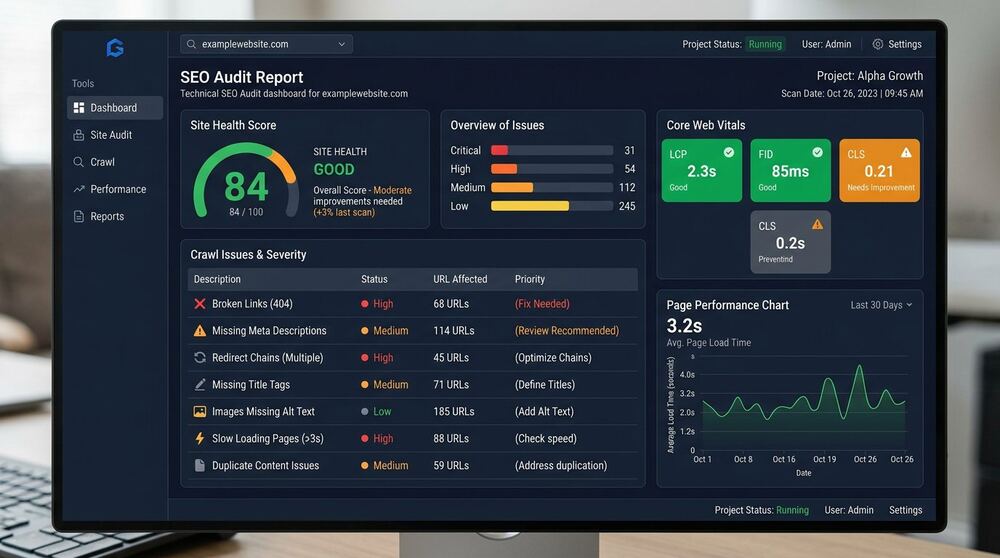
Project type: technical SEO audit. Objective: audit a business website's technical health end-to-end — crawlability, indexation, metadata, speed, structured data and Core Web Vitals — and deliver a prioritized fix list any developer can implement. Services involved: technical SEO analysis and reporting. Business purpose: remove the hidden technical barriers that silently limit rankings and conversions.
Responsibilities & tools
Crawl analysis, indexation review, speed diagnostics, schema recommendations, fix prioritization.
Deliverables in detail
- Full site crawl: broken links, redirects, redirect chains
- Indexation audit: noindex issues, canonical errors, duplicate versions
- Metadata review: missing/duplicate titles and descriptions
- Heading hierarchy and semantic structure checks
- Page speed and Core Web Vitals diagnostics (LCP, INP, CLS)
- Structured data gap analysis and JSON-LD recommendations
- Prioritized technical fix roadmap (impact × effort)
Honest status of this work
A complete technical SEO audit report — every issue explained in plain language with its fix, priority level and expected impact.
How the work was evaluated
The SEO work was treated as a decision system, not a promise of rankings. Research, technical evidence, page intent and implementation priority had to agree before ongoing activity could be useful.
The project brief identifies the work as Client Project, in the Business Website context, with a stated timeline of 2 weeks. Those labels are preserved exactly. This review expands the reasoning around the documented scope; it does not add a client name, confidential detail, ranking, revenue figure, conversion rate or other result that is absent from the source record.
From brief to an executable scope
The focus was Technical SEO audit — prioritized crawl-to-fix report in plain language. A useful scope translates that focus into assets and checks that another person can review. It also separates delivery from business outcomes. Delivery can be verified through files, settings, pages, research fields or campaign structure. Business impact requires observation after implementation and can be influenced by the offer, market, budget, competition and client follow-up.
Before execution, the practical questions are straightforward: What must be delivered? Which access or source material is required? Who approves it? What would make the item complete? What remains outside scope? Answering these questions reduces revision loops and protects both the client and freelancer from vague expectations.
Deliverable-by-deliverable quality notes
- Full site crawl: broken links, redirects, redirect chains. This item was reviewed as part of the stated project scope. Its completion check focused on whether the deliverable supported the project goal and could be understood or used by the client after handover, rather than adding an unsupported performance claim.
- Indexation audit: noindex issues, canonical errors, duplicate versions. This item was reviewed as part of the stated project scope. Its completion check focused on whether the deliverable supported the project goal and could be understood or used by the client after handover, rather than adding an unsupported performance claim.
- Metadata review: missing/duplicate titles and descriptions. This item was reviewed as part of the stated project scope. Its completion check focused on whether the deliverable supported the project goal and could be understood or used by the client after handover, rather than adding an unsupported performance claim.
- Heading hierarchy and semantic structure checks. This item was reviewed as part of the stated project scope. Its completion check focused on whether the deliverable supported the project goal and could be understood or used by the client after handover, rather than adding an unsupported performance claim.
- Page speed and Core Web Vitals diagnostics (LCP, INP, CLS). This item was reviewed as part of the stated project scope. Its completion check focused on whether the deliverable supported the project goal and could be understood or used by the client after handover, rather than adding an unsupported performance claim.
- Structured data gap analysis and JSON-LD recommendations. This item was reviewed as part of the stated project scope. Its completion check focused on whether the deliverable supported the project goal and could be understood or used by the client after handover, rather than adding an unsupported performance claim.
- Prioritized technical fix roadmap (impact × effort). This item was reviewed as part of the stated project scope. Its completion check focused on whether the deliverable supported the project goal and could be understood or used by the client after handover, rather than adding an unsupported performance claim.
Technical and practical checks
- Check 1: Separate crawl or indexation defects from content opportunities and off-site assumptions.
- Check 2: Map every priority query family to one intended page and review possible cannibalization.
- Check 3: Explain each recommendation with impact, evidence, owner and a way to verify completion.
- Check 4: Use Search Console and analytics as directional evidence while acknowledging seasonality and other influences.
Quality assurance should follow the real delivery environment. That may mean reviewing mobile pages, validating a spreadsheet sample, checking search terms in an account, or opening exported creative at platform size. A tool report is supporting evidence; it is not a replacement for using the deliverable as the intended person would.
Measurement without invented results
The documented outcome for this project is: A complete technical SEO audit report — every issue explained in plain language with its fix, priority level and expected impact. This wording describes what was delivered. Where the source does not include post-delivery numbers, this case study does not manufacture them. A responsible next phase would establish a baseline, define the relevant business action and observe a suitable period before drawing conclusions.
Useful measurement depends on the project category. Website work may track form health, speed and qualified enquiries; SEO work may review indexation, relevant query visibility and organic actions; advertising may connect platform conversions to accepted leads; research may track verification and sales acceptance; design may assess readability, consistency and response in context. These are measurement options, not claimed results for this project.
What this case study can help a prospective client decide
A prospective client can use the scope to compare needs, not to assume an identical project. The most useful information to share before requesting a quote is the business goal, audience, current assets or accounts, required deliverables, target market, deadline and known constraints. That makes it possible to recommend a focused starting point and identify dependencies before a price is confirmed.
Project questions
Can the same approach be used in another industry?
The planning principles can transfer, but the research, language, audience and acceptance criteria must be adapted. Reusing a process is sensible; copying assumptions, creative or keywords without market evidence is not.
Does this case study guarantee the same outcome?
No. It documents the existing project scope and delivered status. Search, advertising, sales and website outcomes depend on factors beyond a single deliverable. Any new project should begin with its own baseline and written scope.
What should be provided for a similar quotation?
Share the goal, relevant URL or account context, audience and location, available content or data, deadline and preferred communication route. Use the contact page to discuss the scope, or compare the documented starting points on the pricing page.