
How to Generate B2B Leads: A Practical Framework
B2B lead generation fails when it's random. A complete framework: define the ideal profile, build targeted lists, verify data, reach out properly and measure everything.
Ask a struggling sales team what they need and the answer is almost always "more leads". Ask them a week later and it becomes "better leads". B2B lead generation is not a volume game — it is a precision game. A list of 150 companies that genuinely fit your offer will outperform a scraped list of 15,000 that do not, every single time.
This article lays out the framework professionals use to generate B2B leads that sales teams actually thank you for.
Step 1: Define the ideal customer profile (ICP)
Before any research, get brutally specific about who buys:
- Firmographics: industry, company size, geography, revenue band, technology used.
- Trigger events: hiring sprees, funding rounds, new leadership, expansion — signals that now is the right time.
- Buying roles: the decision maker who signs, the influencer who champions, the blocker who can say no.
- Disqualifiers: what makes a company a waste of effort, written down so you filter ruthlessly.
A tight ICP is what separates lead generation from data collection.
Step 2: Build a targeted list — deliberately
With the profile defined, research companies that match it:
- Source: industry directories, LinkedIn, Google Maps, association member lists, conference exhibitors, job boards (companies hiring for a related role often need help now).
- Qualify each company against the ICP before it enters the list. Relevance beats volume.
- Find the right person — name, job title, and a business reason they care about your offer.
- Capture contact data with source notes, so any entry can be traced and audited later.
This is the part that takes real work and where automated scraping fails: context. A good researcher understands why a company belongs on the list, not just that it exists.
Step 3: Verify and clean the data
B2B contact data decays fast — people change jobs, companies rename, emails go dark. Industry experience suggests a meaningful share of any list goes stale within a year. Before outreach:
- Verify email deliverability (syntax, domain, mailbox-level checks) to protect your sender reputation.
- De-duplicate across companies and past campaigns.
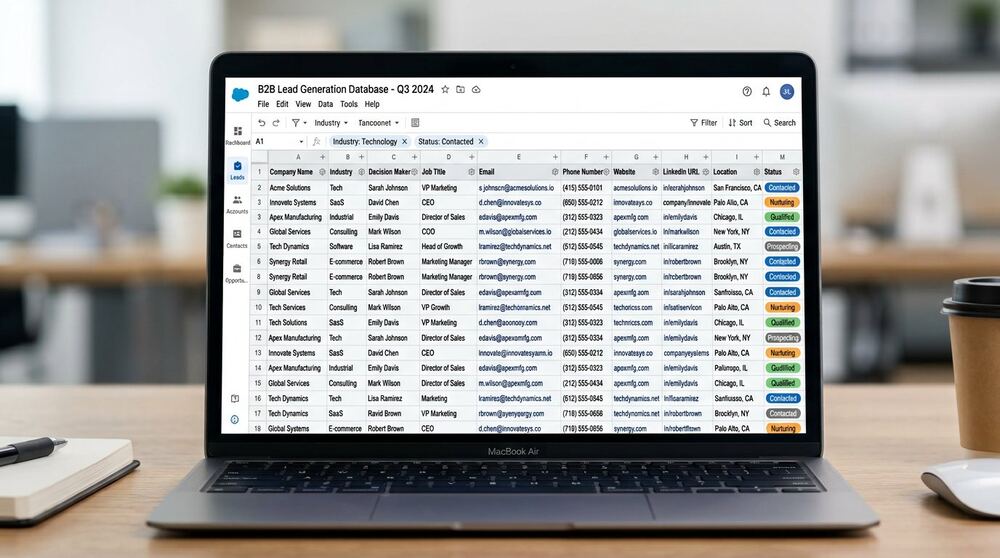
- Standardize formats — names, titles, companies, websites, phone numbers, LinkedIn URLs.
- Organize in a clean CRM or sheet with clear columns: company, industry, size, contact, role, source, status, notes.
Clean data is not glamorous. It is also the difference between campaigns that land and campaigns that bounce.
Step 4: Outreach that respects the buyer
B2B buyers delete generic blasts in under a second. What earns replies:
- Relevance in line one. Reference their industry, a recent company event, or a specific problem you noticed.
- Brevity. Three to five sentences. One clear idea. One soft ask ("worth a short call?").
- Value before ask. Lead with an insight, a relevant example or a useful resource — not with your brochure.
- Multi-touch, patient cadence. 3–5 touches over 2–3 weeks across email and LinkedIn, then stop cleanly.
- Human sending. Real address, plain formatting, easy reply path. Deliverability and reputation are assets you keep.
- Buying cheap bulk lists — high bounce rates, damaged sender reputation, wasted sales time.
- Skipping verification — one bad campaign can impair deliverability for months.
- Marketing-qualified leads that sales cannot use: missing titles, wrong industries, no context.
- No feedback loop between sales and the list builder — the single biggest quality lever goes unused.
- Define geography inside the ICP. "SaaS companies" is not a list; "B2B SaaS companies with 20–200 employees in the UK and Ireland" is. Country, region and timezone belong in the profile from the start.
- Respect regional outreach rules. Cold-email and data regulations differ across the USA, UK/EU, Canada and Australia. Build lists that comply with the rules of the market you are contacting — this affects data fields, opt-out handling and sending practices.
- Localize personalization. Reference the prospect's market reality — local competitors, local industry events, local terminology. A first line that could only have been written for that company beats any template.
- Verify more strictly across borders. Bounce rates hurt deliverability everywhere, but recovery is slower when you cannot pick up the phone easily. Verify every address at mailbox level before the first send.
- 1. firmographic and problem-based ICP criteria. Note its source, date and any limitation before using it to make a decision.
- 2. decision-maker roles and buying triggers. Note its source, date and any limitation before using it to make a decision.
- 3. verifiable public data sources. Note its source, date and any limitation before using it to make a decision.
- 4. offer, outreach channel and qualification rules. Note its source, date and any limitation before using it to make a decision.
- records meeting every ICP rule: define where the number comes from, how often it will be reviewed and what business question it answers. Compare like-for-like periods and annotate major releases or campaign changes.
- verified contact coverage: define where the number comes from, how often it will be reviewed and what business question it answers. Compare like-for-like periods and annotate major releases or campaign changes.
- positive reply and meeting quality: define where the number comes from, how often it will be reviewed and what business question it answers. Compare like-for-like periods and annotate major releases or campaign changes.
- accepted opportunities by source: define where the number comes from, how often it will be reviewed and what business question it answers. Compare like-for-like periods and annotate major releases or campaign changes.
- scraping without quality control. Treat this as a review trigger, not a reason to abandon the channel. Check the underlying evidence, correct the process and document what changed.
- buying stale lists. Treat this as a review trigger, not a reason to abandon the channel. Check the underlying evidence, correct the process and document what changed.
- generic mass outreach. Treat this as a review trigger, not a reason to abandon the channel. Check the underlying evidence, correct the process and document what changed.
- ignoring market-specific data rules. Treat this as a review trigger, not a reason to abandon the channel. Check the underlying evidence, correct the process and document what changed.
Step 5: Measure the pipeline, not the activity
Track the funnel honestly: companies contacted → opened → replied → meeting booked → opportunity → closed. Every stage conversion tells you what to fix — list quality (low opens), message (low replies), offer (meetings that go nowhere). Review weekly, refine the ICP as patterns emerge, and retire what stops working.
Common failure modes
Where this service fits
I provide B2B lead generation as a done-for-you research service: audience definition, prospect research, targeted lead lists, contact research, data cleaning and organized delivery in your preferred format — scoped per project and priced transparently on the pricing page. Agencies, SaaS companies, consultants and local service providers use these lists for cold email, ads audiences and direct sales. If your team has capacity but lacks precision targets, let's scope your ideal profile together.
B2B lead generation for international markets
The framework above works in any country — but cross-border prospecting adds practical considerations worth planning for:
The dedicated international playbook — market selection, sourcing, verification and outreach-ready formatting — is in B2B lead generation for international markets.
Frequently asked questions
How many leads do I need to start outbound?
Start with a tightly defined batch of 100–300 ideal-fit prospects rather than thousands of loose matches. Quality signals from a small precise list teach you more than silence from a large vague one.
What fields should a B2B lead list include?
At minimum: company, industry, company size indicators, contact name, verified title, verified email, phone where available, LinkedIn URL, source, and a personalization note. The full field standard is in how to build a targeted lead list.
Should I buy a lead database or build a custom list?
Bulk databases trade precision for volume — and stale data kills deliverability. A custom-built, verified list matched to a strict ICP costs more per contact but converts better and protects your sender reputation.
Do you build lead lists for specific countries or industries?
Yes — lists are built around your ICP sentence, including country, industry, company size and decision-maker titles. See lead generation services or send your ICP for an honest feasibility answer.
Continue reading
Go deeper: how to build a targeted lead list for sales and ads, B2B lead generation for international markets, and how small businesses can start with digital marketing.
Applied workbook: turn the guidance into a working plan
This section is for a small B2B team building a repeatable prospecting process. Its purpose is to help you connect a precise ideal-customer profile with ethical research, relevant outreach and sales feedback. It expands the principles above into a planning document you can use with a colleague, freelancer or agency. It is not a promise of a ranking, lead volume or return. Those outcomes depend on the market, offer, website, competition, budget and quality of execution.
Use this How to Generate B2B Leads: A Practical Framework workbook on one real priority rather than answering it in the abstract. A useful plan names the page, campaign, audience or dataset being discussed; identifies the evidence available today; and gives the next action to a specific owner. If information is missing, write that down as a research task instead of filling the gap with an assumption.
A realistic planning situation
Consider this hypothetical situation: a company has a broad target market, an inconsistent spreadsheet and outreach messages that could apply to almost any business. The example is intentionally general and does not describe a named client. It shows why the topic cannot be solved by copying a template. The right response begins by separating what is known from what merely sounds plausible.
For How to Generate B2B Leads: A Practical Framework, first describe the commercial objective in one sentence. Then describe what a useful visitor, lead or customer would do next. Finally, identify the present obstacle. It might be missing demand, weak relevance, technical friction, an unclear offer, poor measurement or insufficient follow-up. Each obstacle leads to different work, so this diagnosis prevents a tool from deciding the strategy.
For the How to Generate B2B Leads: A Practical Framework situation, create two columns: evidence and assumptions. Evidence may include search queries, campaign terms, page behavior, sales notes, crawl output or verified records, depending on the topic. The plan should test the most important assumption while protecting what the available evidence already supports.
Information to collect before implementation
Do not wait for perfect data, but collect enough information to avoid an expensive guess about How to Generate B2B Leads: A Practical Framework. The following inputs are specific to this topic:
Place the How to Generate B2B Leads: A Practical Framework inputs in one brief. Add the target market, device or location where it changes the answer. For international work, terminology and competition can differ between the United States, United Kingdom, Canada, Australia, Europe and Bangladesh; that does not justify repeating country names throughout the copy. It means the research should reflect the audience that will actually see the page or campaign.
Finish the How to Generate B2B Leads: A Practical Framework brief with constraints: budget, deadline, access, approval time, technical capacity and legal or platform requirements. Constraints make priorities visible and help a specialist recommend a focused first phase instead of pretending every possible task belongs in the initial scope.
Four decisions to make deliberately
1. Narrow the ICP
Use industry, size, geography, trigger and disqualifier criteria. Write down the current evidence before changing anything. Then make one controlled decision and record who owns the next action.
Working note for Narrow the ICP: connect this decision to connect a precise ideal-customer profile with ethical research, relevant outreach and sales feedback. Record the assumption, the evidence available now and the condition that would make you revise this specific choice. That keeps the work practical and prevents a checklist from replacing judgement.
2. Research for relevance
Capture why the account fits, not only contact fields. Apply this to the page, campaign or workflow that matters most first. A narrow test is easier to interpret than a site-wide change made without a baseline.
Working note for Research for relevance: connect this decision to connect a precise ideal-customer profile with ethical research, relevant outreach and sales feedback. Record the assumption, the evidence available now and the condition that would make you revise this specific choice. That keeps the work practical and prevents a checklist from replacing judgement.
3. Qualify before volume
Test a small sample with sales before expanding the list. Explain the choice in plain language to the person approving the work. If the reason cannot be explained clearly, the scope probably needs more research.
Working note for Qualify before volume: connect this decision to connect a precise ideal-customer profile with ethical research, relevant outreach and sales feedback. Record the assumption, the evidence available now and the condition that would make you revise this specific choice. That keeps the work practical and prevents a checklist from replacing judgement.
4. Close the feedback loop
Return reply and opportunity quality to the research criteria. Set an explicit review point. The first implementation may reveal a different constraint, so the plan should allow evidence to change the next priority.
Working note for Close the feedback loop: connect this decision to connect a precise ideal-customer profile with ethical research, relevant outreach and sales feedback. Record the assumption, the evidence available now and the condition that would make you revise this specific choice. That keeps the work practical and prevents a checklist from replacing judgement.
How to move from plan to implementation
Turn the four How to Generate B2B Leads: A Practical Framework decisions into a short backlog. Each item should contain an owner, the asset or account affected, the expected user benefit, the evidence behind it and a completion check. Broad instructions such as “improve it” are not executable; name the exact page, campaign, file or workflow and the check that will close the task.
For the How to Generate B2B Leads: A Practical Framework plan, work in dependency order. Measurement and access usually come before optimization, and a clear offer or source dataset comes before scaling distribution. The correct sequence reduces rework and makes later evidence easier to interpret.
Keep a dated change log for How to Generate B2B Leads: A Practical Framework. Record the content, technical, tracking, audience, creative or data rule that changed—whichever applies here. Platforms change continuously, but undocumented internal releases cause just as much confusion. A log separates deliberate work from seasonality and normal fluctuation.
Review the How to Generate B2B Leads: A Practical Framework implementation as the intended user would. Use the actual device, landing page, account view, spreadsheet or conversion path; then complete the intended task. Technical correctness matters, but the work is unfinished when a real person cannot understand or use it.
Measurement that supports a decision
A reporting dashboard for How to Generate B2B Leads: A Practical Framework is useful only when each number changes a decision. Start with the following topic-specific measures:
For How to Generate B2B Leads: A Practical Framework, use both leading and outcome indicators. A leading indicator shows whether implementation is moving in the intended direction; an outcome indicator shows whether that direction supports the business. The measures listed above make that distinction concrete, and neither group should be interpreted alone.
Avoid presenting correlation as certainty when reporting on How to Generate B2B Leads: A Practical Framework. Traffic, cost or conversion can change because of seasonality, competitors, pricing, creative, tracking or demand. Report the release, the observation and the next test instead of claiming credit the data cannot isolate.
Quality-control and risk review
Before calling the How to Generate B2B Leads: A Practical Framework work complete, check for these topic-specific warning signs:
Also run a cross-channel check around How to Generate B2B Leads: A Practical Framework: links should resolve to the intended URL, important content should be available on mobile, images should have accurate alternative text where needed, forms should explain what happens next, and analytics should not claim more than the implementation supports. These details affect accessibility, trust and measurement together.
Ask someone who was not involved in the Lead Generation implementation to explain the page, campaign or process after a short review. If their understanding differs from the intended message for How to Generate B2B Leads: A Practical Framework, improve the work before adding more traffic or content. Clarity is often the cheapest useful improvement available.
A 30-day review rhythm
For How to Generate B2B Leads: A Practical Framework, use this first-month rhythm: Days 1–3: establish the baseline and choose one priority. Days 4–10: complete the first controlled implementation and quality checks. Days 11–20: observe early signals without reacting to every daily movement. Days 21–30: compare the evidence with the original assumption and approve the next iteration.
The exact Lead Generation timing depends on how quickly reliable evidence appears. Technical defects can be verified after release, organic search effects often need longer observation, and paid campaigns still need enough qualified activity to support a decision. Review How to Generate B2B Leads: A Practical Framework at a pace that matches the system rather than an arbitrary daily reporting habit.
Document the handover
Close the How to Generate B2B Leads: A Practical Framework cycle with a one-page handover. List the objective, the assets or accounts changed, access ownership, the baseline date, completed checks, unresolved risks and the next review date. Attach the small number of reports or source files another person would need to continue the work. For a small B2B team building a repeatable prospecting process, this record is especially useful because it turns Lead Generation activity into an understandable operating process instead of knowledge held by one provider. The handover should also state what was not done and why. That boundary prevents later assumptions about scope, makes future quotations easier to compare and protects authentic reporting. If a result has not yet had enough time or data to evaluate, label it as pending rather than positive or negative. Clear documentation is part of delivery, not an optional administrative extra.
Workbook questions
What should I do first?
For How to Generate B2B Leads: A Practical Framework, start by writing the objective and collecting the four inputs above. Then choose the decision that removes the largest current uncertainty. That is usually more valuable than selecting the easiest task or the tool with the most recommendations.
How do I know whether I need professional help?
Professional support with How to Generate B2B Leads: A Practical Framework is useful when access, technical implementation, research depth or ongoing management exceeds the time and skills available internally. Ask for a written scope, named deliverables, ownership and reporting method. You should understand the Lead Generation work even when you are not doing it yourself.
Can this process guarantee a result?
No. This How to Generate B2B Leads: A Practical Framework process improves decision quality and implementation discipline; it cannot control competition, platform auctions, algorithm changes, customer demand or sales follow-up. Be cautious with anyone who guarantees rankings, leads or revenue without those dependencies.
How does Prosengit Kundu approach this work?
For work related to How to Generate B2B Leads: A Practical Framework, Prosengit Kundu connects the Lead Generation decision with its technical destination where relevant: content, advertising, social or YouTube marketing, B2B research, and custom HTML/CSS/JavaScript or WordPress development. The scope begins with the goal and available evidence. Review the digital marketing and website services, see related case studies, or describe the project.
Work With Me
Enjoyed this guide? I provide freelance SEO, international SEO, custom HTML/CSS/JavaScript web development, Google & Meta Ads management, B2B lead generation and complete digital growth plans — for clients in Bangladesh and remotely worldwide.